Thursday, 19. June 2025
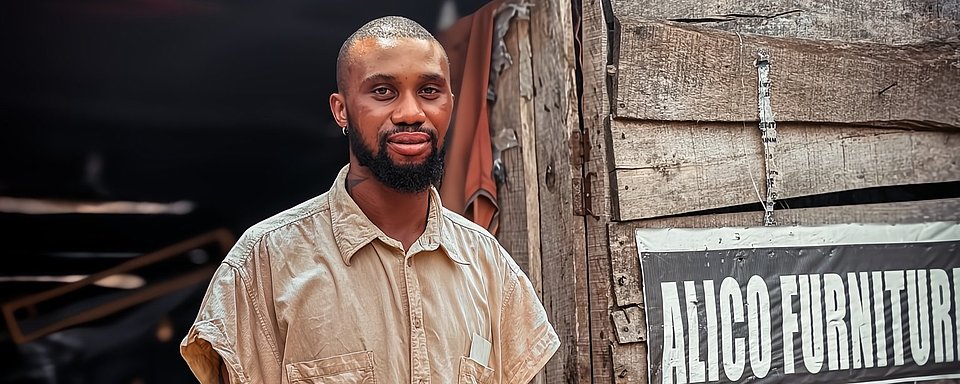
After 13 years abroad, Benjamin returned to Benin City with his family and opened a building materials shop. When a major theft wiped out his stock, he pivoted to a trade learned from his father—upholstery—and steadily rebuilt his income with help from ARRIVES.
After years in Germany, Benjamin came home with fresh hope—his thirst for familiarity finally quenched. The road back to Benin City in Nigeria had taken a long detour—thirteen years, in fact—but it gave him something he had missed for too long: autonomy. “In Germany, I worked like a machine,” he says. “But here, I work for myself. I rest when I want.”
He didn’t come back alone. His wife, a proud Benin woman, and their four children returned with him. They had built a life abroad, but it had stretched thin—pummelled by long working hours, rising living costs, and a deepening longing to feel rooted again.
In Benin City, Benjamin began putting his business plan into motion. With guidance from his ARRIVES reintegration team and in-kind support from the European Union Reintegration Programme (EURP), he opened a building materials shop along the busy Sapele Road in Dumez Junction, one of the city’s fast-growing construction corridors. His family also received additional support on rental costs and school tuition.
Business grew steadily. For the first time in years, Benjamin felt a sense of stability—a reassurance that if he worked diligently, he could grow the shop and bring to life the plan he had nurtured in Germany.
Three weeks into his business, Benjamin arrived at his shop one morning to devastation: two broken padlocks, a twisted entrance door, and a room that had once brimmed with promise. His entire inventory—nearly half a trailer load—was gone. “I lost all my goods,” he explained. “Not just mine, but my neighbours’ too.”
Benjamin had faced hardship in Germany. But this one cut deeper. What was taken from him wasn’t just cement and rods. It was the stability his family was just starting to imagine—and the weight of his family’s dashed hopes.
“I know it is not my fault, but the guilt was unbearable,” says Benjamin. His voice carried both defiance and grief. Still, Benjamin knew there was no time for despair. The Benin City he returned to was markedly different: expanded roads, bustling markets, more stable electricity, and a cultural vibrance he hadn’t seen before. He knew he had to pivot.
In that moment, Benjamin reassured his wife that their vision could still be reclaimed. He decided to turn to something familiar: upholstery—a craft passed down from his father, whose hands had once guided his own as he breathed new life into furniture.
At first, returning to upholstery—crafting and repairing padded furniture—felt disorienting. He knew the materials, but they felt strange in his hands. Benjamin spent hours each day at a nearby carpenter’s workshop, borrowing tools and relearning techniques by trial and memory.
“I used to come here to learn upholstery,” he says. “I am not fast yet. Maybe a faster person can finish in one hour. But I’ll get better. I don’t want complaints from customers.” His tone was quiet but firm. “After my father finished sewing clothes,” Benjamin recalls, “he would give me the fabric to lay on the chairs.” What began as a childhood curiosity had become a second lifeline.
“It’s not every day that people buy chairs,” Benjamin says. “But when the money comes, it’s big.”
As he honed his skills, Benjamin continued his coaching sessions with the ARRIVES programme. Over fifteen one-on-one sessions, his coach helped him sharpen his entrepreneurial skills and rethink the value he offers his customers.
“I’ve learned how to talk to people about my work,” he says. “Even when I don’t have any more stock in my store, I can still make money. I can help people furnish their bedrooms, even their kitchens.”
This soon became his intermediary business model. He began acting as a connector—linking clients with skilled carpenters and fabric sellers—and taking a modest commission for brokering the job.
"Even when I can’t do a job," he quipped, "I always know someone who can. And that gets me more jobs." What began as survival had become his strategy.
Benjamin doesn’t romanticise the life he left behind. He still speaks some German and keeps in touch with old friends from Munich. But when asked if he’d ever return, he shakes his head.
“Germany taught me discipline,” he says. “But here in Nigeria, I have control over my time, my work. I can be with my family. I can provide.” He glances at a chair he’s just finished. Clean lines. A sturdy frame. A job well done. “If you work hard and work smart, the money can be the same,” he says with conviction. “But this time, it’s mine—my own success.”
If you or someone you know is considering voluntary return from Germany to Nigeria, contact ARRIVES today to learn more about how we can help.
You can also visit our return support page for step-by-step guidance on the support we offer, or explore our FAQ page for answers to frequently asked questions about ARRIVES.
ARRIVES is a project co-implemented by Social Impact, International Returns and Reintegration Assistance (IRARA) and International Trade Centre (ITC). It is funded by the Asylum, Migration and Integration Fund (AMIF) of the European Commission and the German Federal Office for Migration and Refugees (BAMF).