Friday, 11. April 2025
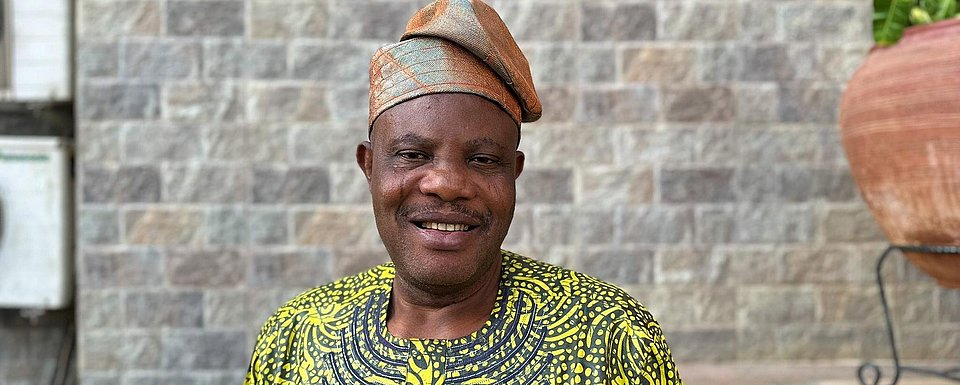
When his move to Germany didn’t go as planned, Pa Ayilara chose to return to Nigeria with support from ARRIVES. Now reunited with his family, he’s building the cassava farming business he’d always dreamed of running.
At a temporary shelter in Germany, 66-year-old Asimiyu Ayilara often dreamed of his cassava farm in Nigeria—the joy of tending to its stems ahead of the rainy season. He had left Nigeria with hopes of earning more money to expand his small farm in the city of Ibadan. But instead, he found himself stranded—without valid German work papers and with few job opportunities available to someone his age. That was until he crossed paths with ARRIVES.
If there’s one thing Pa Asimiyu Ayilara refuses to let go of at his age, it is becoming a major supplier of farm produce. He nurtured this dream since his youthful days, hoping to make a great amount of investment to improve his yields.
Back in the ‘90s, farming gave him everything—a family, the means to raise his children, and a respected place in his community. But for decades, no matter how much he planted, demand outpaced supply.
"It was a water don pass garri situation," he recalls, as farmers faced immense pressures to keep up with the market’s insatiable hunger. The weight of it gnawed at his pride — how could a seasoned farmer like me fall short? This ultimately fueled his decision to migrate. “When we cannot produce enough,” he lamented, “we cannot feed people. We cannot make a profit.”
In his long farming career, the obstacles Pa Ayilara faced were as countless as the seasons he had endured: denied loans, restrictive policies, limited farmland, and missed agribusiness grants. Yet, he never lost sight of farming’s untapped potential. His vision to harness that potential persisted, even as years of his experience taught him patience. “Farming teaches you to wait for the harvest,” he muses. “But the sun comes and goes—it waits for no one. You must know when to act."
That lesson stayed with him, pushing him at 65, toward one of the boldest moves of his life. With little more than his passport, a visiting visa to Germany for a breakthrough in business.
Pa Ayilara told no one about his plans—not his children, not his friends. Only his wife knew, and even she didn’t find out until he was already halfway out the door. "I told my wife, and she wasn’t happy," he admits. When his children eventually learned of his departure, they protested, worried about his well-being. But Pa Ayilara wasn’t seeking permission. No one could talk him out of it. He waved off their concerns, reminding them that he was the head of the family, had traveled before, and knew exactly what he was doing.
The moment his plane touched down in Germany, reality struck—no work permit, no welcoming hand to guide him. "I thought I knew about the place," Pa Ayilara admits. "Then I realised I wasn’t as prepared as I thought."
To legalise his stay, he applied for asylum, believing it was his best chance. Nigeria’s economy had been waka come, waka go for years – always shifting, never stable – stifling his farming aspirations. Germany had euros—strong and stable. But disillusionment came swiftly. The migration office made it clear: asylum was for those fleeing war or persecution.
Now, Pa Ayilara had to explain how running a business in Nigeria felt like a battlefield. "They could have let me stay," he says. "If only they had seen the price of garri lately. Maybe they’d understand." But even if they had allowed him to stay, another challenge awaited Pa Ayilara. He was above sixty and getting employed at that age in Germany, he explains, is near impossible. So, his japa journey—an attempt to escape to a better chance at life—turned into an unexpected retirement tour.
After his asylum request was denied, months of uncertainty followed. Pa Ayilara found himself in a shelter, where a language barrier left him isolated. “The food, the cold—it made me sad,” he says. Still, he was grateful for the kindness of the social workers at the shelter. He befriended a Ghanaian man his age, who shared his regrets. They spoke about their families, their hopes, and the struggles of migration. They even bonded over their shared confusion about German paperwork.
These conversations, along with calls from his children, offered some comfort. But guilt lingered. "The problem with moving abroad is that you don’t fully understand the challenges until you get there," he reflects. "I wish I had asked more questions before leaving."
His deepest regret wasn’t just time lost—it was the life he had left behind. Six months in the shelter felt like waiting for a miracle that never came. Had he stayed on his farm, he would be harvesting cassava by now. Worse still, part of the money for his journey had come from selling farm machinery he used to process garri. "I don’t feel good about the money I spent," he admits. "If I had invested it in my farm, I would be enjoying the fruits of my labor with my people."
Missing home, Pa Ayilara decided to leave after a short period in Germany. Social workers at the shelter connected him to the ARRIVES project, ensuring he wouldn’t return empty-handed.
Soon after returning to Nigeria, ARRIVES facilitated his access to €2,000 in in-kind support from the EU Reintegration Programme (EURP), which he used to purchase farming supplies. With business coaching from the project, he revived his six-hectare farm, improving soil conditions and expanding beyond cassava by introducing beans, cowpeas and maize. The mixed cropping system helped diversify his revenue streams while making both his income and soil health more sustainable. Today, his farm employs ten workers. "I am back to my family and the farming business I love," he says.
With guidance from ARRIVES, Pa Ayilara is securing 40 hectares of government-issued land on a 99-year lease—finally realising his dream of a more productive farm. With government-subsidised access to farming supplies and modern equipment, he plans to cultivate a large portion of the land while leasing part of it to other farmers.
He is finalizing a ₦5 million loan from the Bank of Industry and has registered his business with the Small and Medium Enterprises Development Agency of Nigeria (SMEDAN). With the added support, he aims to scale his garri production by acquiring more processing equipment.
For Nigerians struggling abroad, Pa Ayilara has one piece of advice: “Don’t stay there if you are doing nothing. And sometimes, going back home is the best way forward. Home is home.”
If you or someone you know is considering voluntary return from Germany to Nigeria, contact ARRIVES today to learn more about how we can help.
You can also visit our return support page for step-by-step guidance on the support we offer, or explore our FAQ page for answers to frequently asked questions about ARRIVES.
ARRIVES is a project co-implemented by Social Impact, International Returns and Reintegration Assistance (IRARA) and International Trade Centre (ITC). It is funded by the Asylum, Migration and Integration Fund (AMIF) of the European Commission and the German Federal Office for Migration and Refugees (BAMF).